
KNOWLEDGE CENTRE · ARTICLE
What Is the Gut Barrier? Why Do Tight Junctions Matter?
The intestinal surface is more than a site of nutrient absorption. It also forms a selective barrier between the gut contents and other body tissues. The tight junctions that connect intestinal cells play an important role in maintaining this integrity.
Probiotic research investigates mechanisms associated with the gut barrier, mucus layer and tight junction proteins. Zinc is also an essential mineral involved in normal intestinal epithelial function. Probiotic bacteria in the Enteromax family and zinc in the relevant formats are parts of a holistic approach to gut barrier support.
The short answer
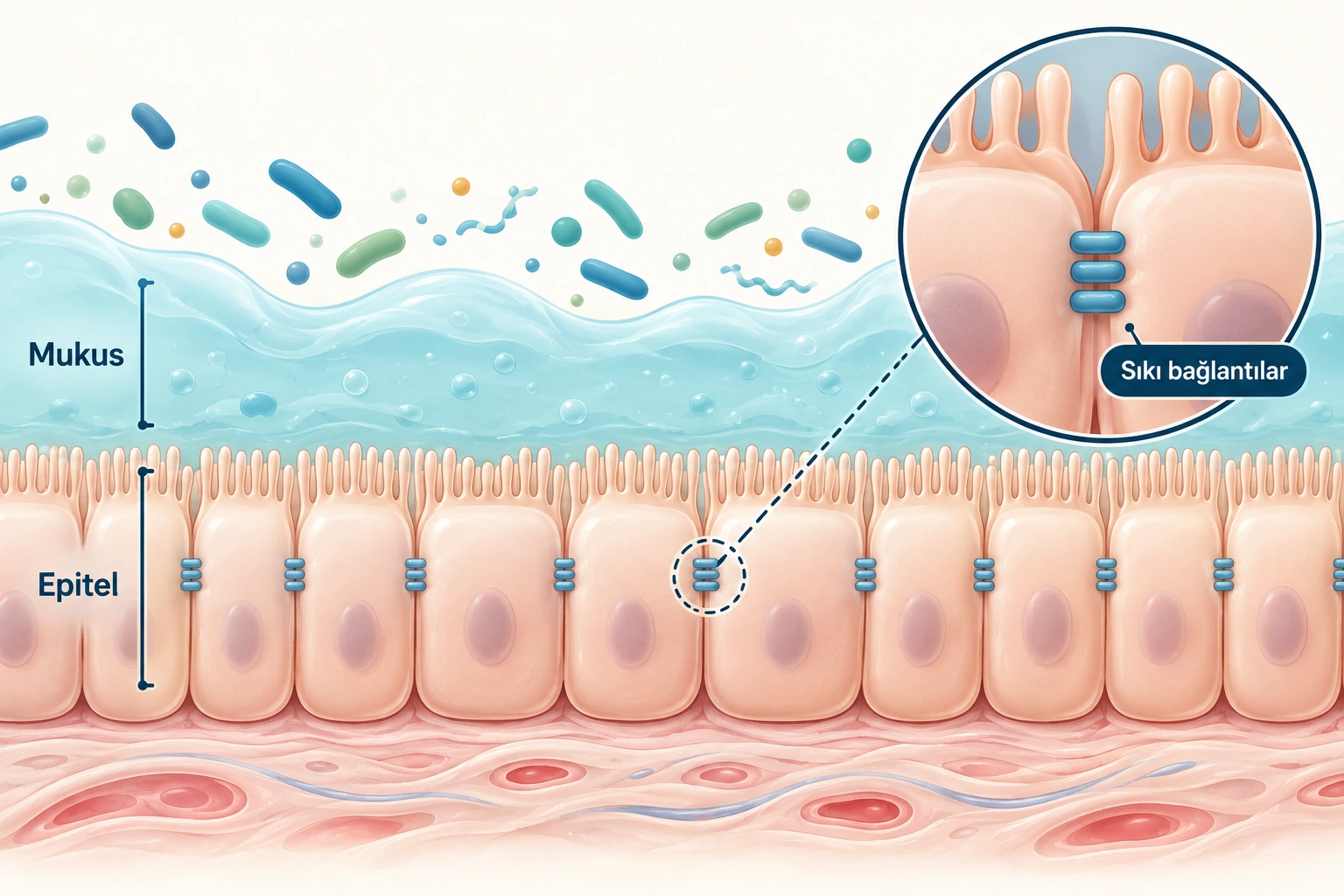
The gut barrier is a multilayered defence and transport system formed by the mucus layer, intestinal epithelial cells, tight junctions between cells, immune components and the microbial ecosystem working together.[1]
Tight junctions are protein complexes that control passage between neighbouring epithelial cells. ZO-1, occludin and claudin-family proteins are important components.
The barrier's main role is to allow controlled nutrient passage while limiting the passage of unwanted substances.
What layers make up the gut barrier?
The gut barrier is a selective protection system made up of layers working in harmony.
1. Mucus layer
Mucus covering the intestinal surface forms a physical and chemical interface between epithelial cells and the gut contents.
It can limit direct contact between microorganisms and the epithelial surface and carries some defence molecules.
2. Epithelial cells
Epithelial cells line the intestinal surface in a single layer. Nutrient absorption occurs through these cells, whose integrity is critical to barrier function.
3. Tight junctions
Tight junctions are protein complexes that control passage between neighbouring epithelial cells.
ZO-1, occludin and claudin proteins are among the most frequently studied components of this system.
4. Immune system and microbiota
Immune cells in the intestinal mucosa and the microbiota interact continuously with the barrier system. Microbial metabolites can affect processes such as mucus production and epithelial function.[1]
What does “intestinal permeability” mean?
The gut barrier is selectively permeable: it allows controlled nutrient passage while limiting the passage of unwanted substances.
Intestinal permeability describes which substances can pass through the intestinal surface and to what extent.
This permeability is part of normal physiology. Problems can arise in clinical conditions where the barrier's selectivity changes substantially.
In scientific assessment, intestinal permeability is considered within the barrier's selective function and clinical context, rather than as a general label explaining a single symptom.
Why do tight junctions matter?
Tight junctions help control the spaces between cells.
These protein complexes:
- limit uncontrolled passage of intestinal contents between cells,
- support epithelial layer integrity,
- contribute to the intestinal surface's selective permeability.
Research may use markers such as ZO-1, occludin, claudins, transepithelial electrical resistance and zonulin when barrier biology changes.
Gut health assessment considers different biomarkers, clinical findings and the person's overall gastrointestinal condition together.
How is the microbiota related to the gut barrier?
The gut microbiota and barrier interact in both directions.
Microbial metabolites such as short-chain fatty acids are associated with epithelial cell energy metabolism and barrier functions. In turn, barrier structure affects how microorganisms contact the intestinal surface.
A 2023 systematic review and meta-analysis of 26 randomised controlled trials involving 1,891 participants examined probiotic interventions' effects on various markers associated with intestinal barrier function. Some barrier markers changed favourably in the probiotic groups.[2]
Studies involve different probiotics, doses and populations; therefore, strain identity and formulation are particularly important when assessing barrier outcomes.
How do strains in the Enteromax formula feature in barrier research?
Some strains in the Enteromax formula have been investigated in different research models for mechanisms associated with the gut barrier.
Preclinical barrier data for LA85
A mouse study of Lactobacillus acidophilus LA85 reported increases in tight junction proteins such as ZO-1, occludin and claudin-1.[3]
This study provides direct strain data on LA85, also included in Enteromax, explaining its tight junction protein-related mechanism at the preclinical level.[3]
Species-level barrier data for Streptococcus thermophilus
Del Piano and colleagues investigated a combination of Streptococcus thermophilus ST10 and tara gum for exopolysaccharide formation in the intestinal lumen and effects on intestinal permeability.[4]
This study adds to the biological background of S. thermophilus in barrier research. Enteromax contains the BIO1488 strain of the same species; BIO1488 represents the formula within this scientific framework through its own strain identity.
How can the gut barrier be supported?
The gut barrier is a multilayered, dynamic system.
The gut barrier is
- diet,
- microbiota,
- gastrointestinal diseases,
- medication,
- immune responses,
- living conditions
are among the many factors that can influence this dynamic system.
When assessing barrier support, diet, microbiota and the barrier-related mechanisms of specific ingredients or microorganisms are therefore considered together.
Conclusion
In summary: The gut barrier is a multilayered system in which mucus, epithelium, tight junctions, immune components and microbiota work together.
What this means in daily life: Symptoms such as bloating and fatigue can have various causes; the gut barrier is only one part of this broader biological picture.
What research shows: In barrier research, strain, dose and research model determine interpretation; human clinical data and mechanistic studies are different, complementary layers of evidence.
Explore more: For the relationship between the barrier and microbiota, read What Is Gut Flora and Why Does It Matter?
Frequently Asked Questions
What is the gut barrier?
It is the system of mucus, epithelium, tight junctions, immune components and microbiota that controls passage between the gut contents and the body's internal environment.
What are tight junctions?
They are protein complexes connecting intestinal epithelial cells and controlling passage between them. ZO-1, occludin and claudin proteins are important components.
Do probiotics strengthen the gut barrier?
Some probiotic interventions have shown favourable results for intestinal barrier markers.[2] Strain identity and formulation are decisive in scientific assessment in this area.
Does zonulin alone indicate intestinal permeability?
Zonulin is one marker used in research; gut barrier assessment combines different measurements with clinical context.
Is “leaky gut” the cause of every case of bloating?
Bloating may involve several processes, including fermentation, gut motility, visceral sensitivity and diet.
Related Vitallin product
To explore formulas combining probiotic and prebiotic ingredients, visit the Enteromax Capsules product page.
The barrier data in this article explain the scientific mechanistic background of probiotic species and strains in Enteromax; the product's own characteristics are presented on its product page.
Information Note
This content is for general information and educational purposes. It is not a substitute for medical advice, diagnosis or treatment. Consult your physician or the relevant healthcare professional for an assessment of your personal health.
This content is for general information and educational purposes. It is not a substitute for medical advice, diagnosis or treatment.
References
- Camilleri M. Leaky gut: mechanisms, measurement and clinical implications in humans. Gut. 2019;68:1516-1526. DOI: 10.1136/gutjnl-2019-318427.
- Zheng Y, Zhang Z, Tang P, et al. Probiotics fortify intestinal barrier function: a systematic review and meta-analysis of randomized trials. Frontiers in Immunology. 2023;14:1143548. DOI: 10.3389/fimmu.2023.1143548.
- Xue et al. Lactobacillus acidophilus LA85 ameliorates cyclophosphamide-induced immunosuppression by modulating Notch and TLR4/NF-κB signal pathways and remodeling the gut microbiota. Food & Function. 2022;13:8107-8118. DOI: 10.1039/d2fo00831b.
- Del Piano et al. Assessment of the capability of a gelling complex made of tara gum and Streptococcus thermophilus ST10 to restore the gut barrier. Journal of Clinical Gastroenterology. 2014;48:S56-S61. DOI: 10.1097/MCG.0000000000000244.