
KNOWLEDGE CENTRE · ARTICLE
What Is Lion's Mane Mushroom?
Lion's mane mushroom (Hericium erinaceus) has a history of traditional use in East Asia. Today, researchers investigate its biological mechanisms associated with the nervous system. Mental clarity, memory, focus and neuroplasticity are among the main areas studied.
The short answer
Hericium erinaceus has two main biological sources studied in research:
- Fruiting body: Studied for its hericenones, beta-glucans and various polysaccharides.
- Mycelium: Studied particularly for its erinacines.
Preclinical studies have investigated the relationships of these compounds with neurotrophic pathways such as NGF and BDNF, synaptic plasticity and neurogenesis.[1]
Human studies have investigated outcomes including cognitive performance, mild cognitive impairment, mental clarity, stress and mood.[2][3] Studies use different mushroom forms, doses and extracts. This diversity helps us understand the different contexts of lion's mane research.
Are the fruiting body and mycelium the same?
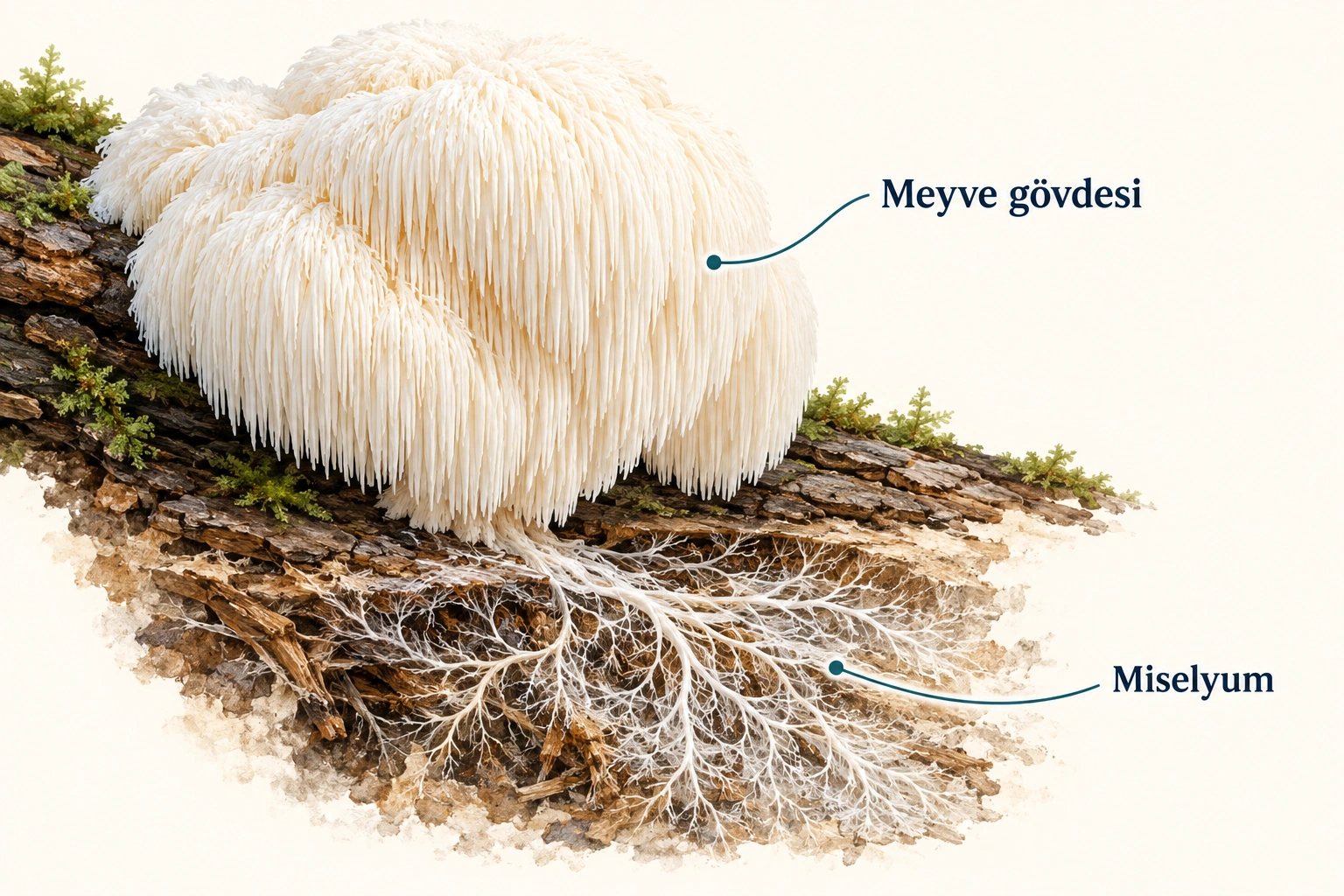
The fruiting body and mycelium are two different biological parts of a mushroom.
The fruiting body is the visible part. The mycelium is the thread-like network that enables the mushroom to grow.
Hericium erinaceus research describes different bioactive profiles for these two sources:
Fruiting body
The fruiting body is studied particularly for:
- hericenones,
- beta-glucans,
- polysaccharides
Mycelium
In the mycelium, erinacines, particularly erinacine A, are prominent in research into neurotrophic mechanisms.
When assessing a lion's mane study, asking “Which part, which extract and which dose?” helps us understand the preparation used.
Why do NGF and BDNF appear in lion's mane research?
NGF and BDNF are neurotrophic proteins associated with nerve cell development, function and plasticity.
Hericium erinaceus research has focused on the effects of hericenones and erinacines in relation to NGF/BDNF pathways.
Much of this mechanistic evidence comes from cell and animal models. Human studies complement this biological background through cognitive performance measures and clinical scales.
What has been investigated in human studies?
Healthy older adults
Saitsu and colleagues' 2019 study assessed a Hericium erinaceus fruiting body product in 31 healthy adults over 12 weeks, reporting some favourable changes in MMSE and Benton visual memory tests.[2]
Although the sample was small, the study is a valuable clinical data point in human cognitive research.
Mild cognitive impairment
Mori and colleagues' 2009 double-blind study of 30 participants with mild cognitive impairment found improvements in cognitive scale scores compared with placebo after 16 weeks of use.[3]
Scores declined during the four weeks after supplementation stopped, an important follow-up finding for understanding the relationship between the effect and duration of use.
Healthy young and middle-aged adults
La Monica and colleagues' 2023 study assessed mental clarity and certain cognitive tasks involving attention and reaction speed after acute use in healthy adults.[4]
This study contributes to lion's mane research particularly in terms of short-term cognitive response.
How is lion's mane related to memory and mental performance?
Alongside its history of traditional use, lion's mane mushroom has recently become a subject of research into memory, focus, mental clarity and nerve cell functions.
Human studies have reported favourable findings on cognitive performance measures. Mechanistic studies of hericenones, erinacines and neurotrophic factor pathways also explain why the mushroom is investigated in this area. [2] [3]
Lion's mane is therefore a valuable scientific topic in content that considers memory, learning and mental performance holistically.
What should be known about lion's mane use?
Lion's mane mushroom has generally been reported as well tolerated in human research. These studies provide information about the user experience alongside data on cognitive functions and neurotrophic processes.
People with known sensitivity to mushroom ingredients should consider the product's composition. For people taking regular medication, those who are pregnant or breastfeeding, and those with specific health conditions, assessment by a healthcare professional is part of appropriate use.
Conclusion
In summary: Hericium erinaceus fruiting body and mycelium have different bioactive profiles and are studied for cognitive and neurotrophic pathways.
What this means in daily life: When assessing a product, the part used, extract, dose and study population should be considered together.
What research shows: Human studies vary in preparation, dose and population; NGF/BDNF mechanism research complements their biological background.
Explore more: To understand the mechanism, read What Are NGF and BDNF?
Frequently Asked Questions
Are Lion's Mane and Aslan Yelesi the same?
Yes. Lion's Mane is the English name for Hericium erinaceus.
Is the fruiting body or mycelium better?
The fruiting body and mycelium have different bioactive profiles, so research investigates both sources in different preparations.
Does lion's mane improve memory?
Some human studies have reported favourable results in cognitive tests.[2][3] These findings support lion's mane's place in cognitive performance research.
Are effects immediate?
Studies have used protocols ranging from a single acute dose to 16 weeks or longer. The duration varies according to the outcome investigated and preparation used.
What is NGF?
It is one of the neurotrophic factors associated with nerve cell survival and development. The difference between NGF and BDNF is discussed in the relevant Knowledge Centre article.
Related Vitallin product
To explore Vitallin's 60-tablet formula, visit the Lion's Mane Mushroom product page.
The clinical findings discussed reflect the scientific background of the preparations studied. Vitallin's 60-tablet formula is presented on the product page with its own composition and directions.
Information Note
This content is for general information and educational purposes. It is not a substitute for medical advice, diagnosis or treatment. Consult your physician or the relevant healthcare professional for an assessment of your personal health.
This content is for general information and educational purposes. It is not a substitute for medical advice, diagnosis or treatment.
References
- Spangenberg ET, Moneypenny A, Bozzo GG, Perreault ML. Unveiling the role of erinacines in the neuroprotective effects of Hericium erinaceus: a systematic review in preclinical models. Frontiers in Pharmacology. 2025;16:1582081. DOI: 10.3389/fphar.2025.1582081.
- Saitsu Y, Nishide A, Kikushima K, Shimizu K, Ohnuki K. Improvement of cognitive functions by oral intake of Hericium erinaceus. Biomedical Research. 2019;40(3):125-131. DOI: 10.2220/biomedres.40.125.
- Mori K, Inatomi S, Ouchi K, Azumi Y, Tuchida T. Improving effects of the mushroom Yamabushitake on mild cognitive impairment. Phytotherapy Research. 2009;23(3):367-372. DOI: 10.1002/ptr.2634.
- La Monica MB, et al. Acute effects of naturally occurring Guayusa tea and Nordic lion's mane extracts on cognitive performance. Nutrients. 2023;15(24):5018. DOI: 10.3390/nu15245018.