
KNOWLEDGE CENTRE · ARTICLE
What Is the Difference Between Probiotics and Prebiotics?
An approach that combines probiotics and prebiotics is called a synbiotic approach. Vitallin Enteromax Capsules and Sachets combine live probiotics and inulin in one formulation. This reflects a holistic formulation approach that provides the microbiota with both live microorganisms and prebiotic support.
The short answer
Probiotics are live microorganisms that provide a health benefit to the host when consumed in adequate amounts.[1]
Prebiotics are substrates selectively used by host microorganisms that provide a health benefit.[2]
Put simply:
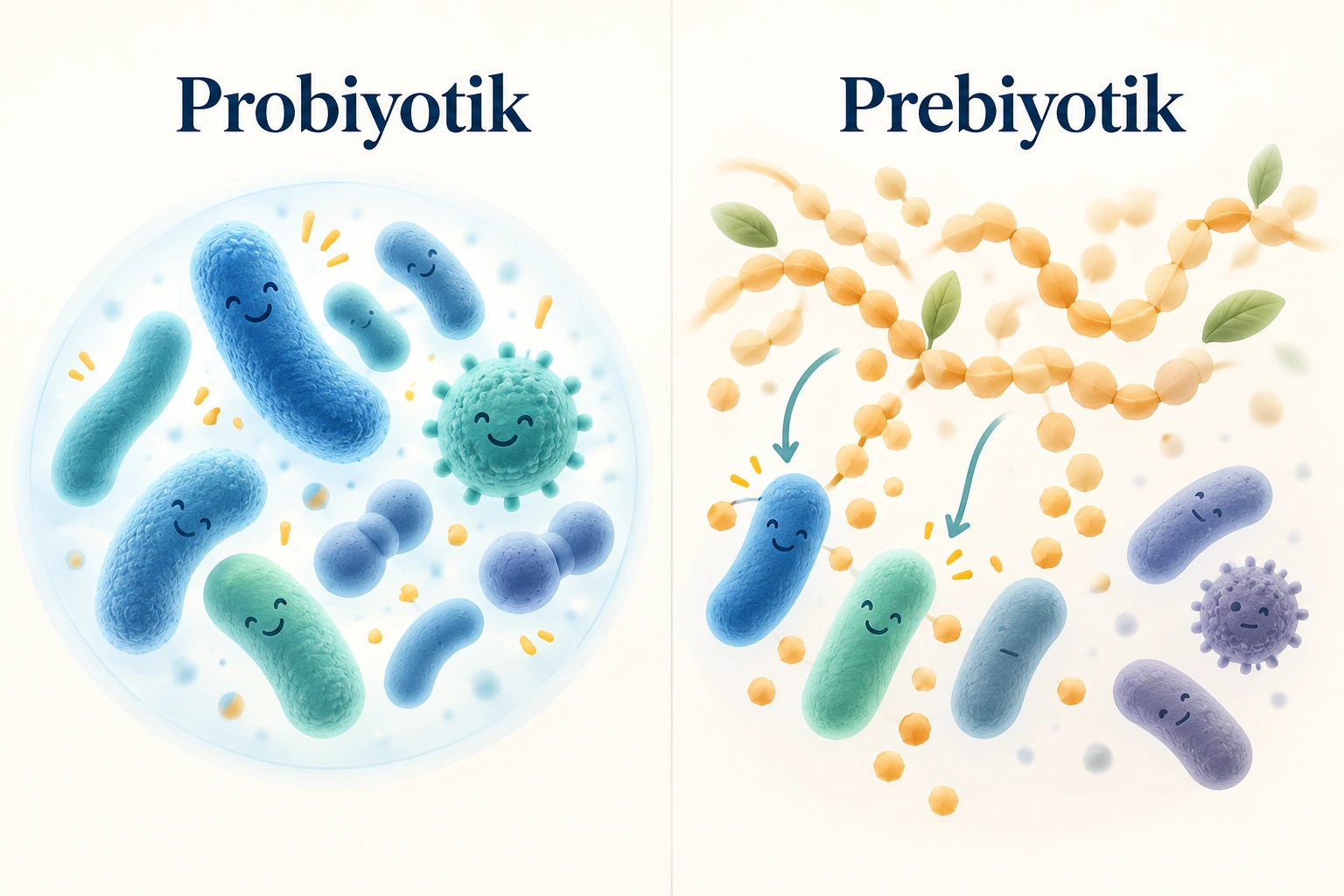
Probiotic = live microorganism
Prebiotic = a substrate that specific microorganisms in the microbial ecosystem can use
The analogy “prebiotics are food for probiotics” is a useful introduction, but the scientific definition is broader. A prebiotic can also be selectively used by specific microorganisms in a person's own microbiota.[2]
What is a probiotic?
The definition of a probiotic includes three elements:
- A live microorganism
- An adequate amount
- A demonstrated health benefit
For a live microorganism to qualify as a probiotic, its defined identity, adequate amount and health benefit must be considered together.
When evaluating probiotic products, consider the microorganism's:
- species,
- strain,
- amount,
- formulation,
- studied population and context of use
Related article: What Are Probiotics? How Do They Interact with the Gut Microbiota?
What is a prebiotic?
According to the 2017 ISAPP consensus, a prebiotic is:
A substrate that is selectively used by host microorganisms and provides a health benefit.[2]
Two concepts are particularly important here:
Selective use
For an ingredient to qualify as a prebiotic, resistance to digestion alone is insufficient; the criteria of selective microbial use and a health benefit must also be met.
Its selective use by specific microorganisms must be demonstrated for it to qualify as a prebiotic.[2]
Health benefit
The definition of a prebiotic considers both selective use by microorganisms and its association with a health benefit.
This use must be associated with a health benefit for the host.[2]
Therefore:
Prebiotics are a specific group of substrates that meet the criteria of selective microbial use and a health benefit.
Likewise, prebiotics should not be reduced to the word “fibre”; the scientific definition uses the broader concept of a substrate.[2]
Is inulin a prebiotic?
Inulin is one of the most widely studied fructan ingredients among prebiotics.
It can reach the large intestine without being fully broken down by human digestive enzymes in the small intestine, where it participates in microbial metabolism.
Inulin is a prebiotic ingredient studied both on its own and alongside probiotics in the context of the gut microbiota.
For example, in Ford and colleagues' 2020 study, 5.6 g/day inulin, a multi-strain probiotic and a combination intervention were assessed in separate study groups.[3] The study focused on microbiota stability and gastrointestinal tolerance in older women following a high-protein diet.
The properties of inulin are discussed in more detail in “What Is Inulin? Why Is It Combined with Probiotics?”
Do probiotics and prebiotics do the same job in the gut?
Probiotics and prebiotics work through different pathways in the gut.
The probiotic approach
This involves consuming specific live microorganisms from an external source.
As these microorganisms pass through the gut, they may interact with the microbiota, gut barrier, metabolites or other microorganisms.
Effects are strain-specific.
The prebiotic approach
Rather than adding new microorganisms, this provides a substrate that specific microorganisms already present in the microbial ecosystem can use.
The underlying principle is therefore:
A prebiotic approach supports specific microbial activities through a dietary substrate.
The two approaches have different biological starting points.
Can probiotics and prebiotics be used together?
Yes. Scientific research includes formulations that combine live microorganisms and microbial substrates.
This brings the concept of a synbiotic into consideration.
The definition of a synbiotic is important here:
For a combination to qualify as a synbiotic, the live microorganisms and selectively used substrate must together form a mixture that provides a health benefit.
According to the 2020 ISAPP consensus, a synbiotic is a mixture of live microorganisms and substrates selectively used by host microorganisms that provides a health benefit.[4]
The consensus defines two approaches:
Complementary synbiotic
The probiotic and prebiotic ingredients each meet their respective criteria independently and are combined in one formulation.[4]
Synergistic synbiotic
The substrate is specifically selected for use by the microorganism provided alongside it; the two ingredients are designed to work together.[4]
This distinction matters: evaluating synergy requires consideration of the probiotic strain, prebiotic substrate and rationale for their combined use.
What does “prebiotics feed probiotics” mean?
This analogy makes the basic idea easier to understand. The scientific definition, however, considers selective use of prebiotics by host microorganisms within a broader framework.
A prebiotic substrate may:
- be used by the probiotic microorganism in the product,
- be used by microorganisms in a person's own gut microbiota,
- have different effects on more than one microbial group.
A more accurate description is therefore:
Prebiotics are substrates selectively used by specific host microorganisms.
The “food for probiotics” analogy is a useful introduction, but the scientific definition of prebiotics also includes selective use within a person's own microbiota.
Are they more effective when used together?
The value of combined use depends on the strains, prebiotic substrate, dose and intended use studied.
The value of a probiotic + prebiotic combination depends on:
- the live microorganisms used,
- the strains,
- the prebiotic substrate,
- the doses,
- the rationale for combined use,
- the population studied,
- the clinical outcome
Ford and colleagues evaluated probiotic, inulin and combined intervention groups in the context of a high-protein diet. The study reported some outcomes associated with gastrointestinal tolerance and overall wellbeing in probiotic and synbiotic interventions.[3]
This study shows that the probiotic + prebiotic approach has been studied in relation to gastrointestinal tolerance and overall wellbeing. Enteromax applies this approach at product level by combining its defined probiotic strains with inulin in the same formulation.
How can prebiotic fibres fit into a digestive routine?
Prebiotic fibres such as inulin are dietary ingredients used by gut bacteria. Fermentation is part of the gut ecosystem's natural function.
When using prebiotic fibres, a person's daily fibre intake, portion size and dietary habits should be considered together. Regular use in appropriate amounts can fit into a comfortable daily routine.
Should you choose a probiotic or a prebiotic?
Probiotics and prebiotics are two different strategies that can complement each other.
The relevance of an approach depends on:
- the intended use,
- the person's diet,
- their gastrointestinal condition,
- the probiotic strain used,
- the prebiotic ingredient,
- the scientific evidence
Some studies investigate a prebiotic alone, others a specific probiotic, and others the two together.
The most useful question in a scientific assessment is therefore:
“Which ingredient is being evaluated, for what purpose and on the basis of what evidence?”
How is this approach reflected in Enteromax formulations?
Alongside probiotic microorganisms, Enteromax Capsules and Enteromax Sachets also contain inulin.
These products contain both probiotic and prebiotic ingredients. Ford and colleagues' study illustrates the research basis of the probiotic + inulin approach; Enteromax's own strain composition and inulin content form the product's specific combination.[3]
Conclusion
In summary: A probiotic is a live microorganism; a prebiotic is a substrate selectively used by specific microorganisms.[1][2]
What this means in daily life: “Probiotic”, “prebiotic” and “synbiotic” do not mean the same thing. When choosing a product, consider the strain, substrate, dose and intended use together.
What research shows: Evaluating a synbiotic effect requires consideration of the live microorganisms, substrate and rationale for their combined use as a whole.[4]
Explore more: To learn more about inulin, see What Is Inulin? Why Is It Combined with Probiotics?
Frequently Asked Questions
Are probiotics and prebiotics the same?
A probiotic is a live microorganism; a prebiotic is a substrate selectively used by specific microorganisms that provides a health benefit.[1][2]
Are prebiotics food for probiotics?
This analogy is a useful introduction. Scientifically, a prebiotic can also selectively support specific microorganisms in a person's own microbiota.[2]
Is inulin a prebiotic?
Yes. Inulin is one of the most widely studied prebiotic fructans.[2]
Can probiotics and prebiotics be taken together?
Yes. Research and formulations combine probiotics and prebiotics.[3][4] The scientific value of a combination depends on the strain, substrate, dose and rationale for their combined use.
What does synbiotic mean?
A synbiotic is a mixture of live microorganisms and substrates selectively used by host microorganisms that provides a health benefit.[4]
Is every probiotic + prebiotic product a synbiotic?
ISAPP uses defined criteria for complementary and synergistic synbiotics.[4]
Can prebiotics cause gas?
Fermentable prebiotics may cause gas and bloating in some people, particularly at high doses or when intake increases quickly. Tolerance varies by person and dose.
Related Vitallin products
To explore Vitallin formulations that combine probiotic and prebiotic ingredients:
visit the product pages.
Information Note
This content is for general information and educational purposes. It is not a substitute for medical advice, diagnosis or treatment. Consult your physician or the relevant healthcare professional for an assessment of your personal health.
This content is provided for general information and education. It does not replace medical advice, diagnosis or treatment. If you have digestive symptoms, a specific health condition or take medication regularly, discuss your choice of probiotic or prebiotic supplement with your doctor or an appropriate healthcare professional.
References
- Hill C, Guarner F, Reid G, et al. The International Scientific Association for Probiotics and Prebiotics consensus statement on the scope and appropriate use of the term probiotic. Nature Reviews Gastroenterology & Hepatology. 2014;11:506-514. DOI: 10.1038/nrgastro.2014.66.
- Gibson GR, Hutkins R, Sanders ME, et al. Expert consensus document: The International Scientific Association for Probiotics and Prebiotics (ISAPP) consensus statement on the definition and scope of prebiotics. Nature Reviews Gastroenterology & Hepatology. 2017;14:491-502. DOI: 10.1038/nrgastro.2017.75. PMID: 28611480.
- Ford AL, Nagulesapillai V, Piano A, et al. Microbiota Stability and Gastrointestinal Tolerance in Response to a High-Protein Diet with and without a Prebiotic, Probiotic, and Synbiotic: A Randomized, Double-Blind, Placebo-Controlled Trial in Older Women. Journal of the Academy of Nutrition and Dietetics. 2020;120(4):500-516.e10. DOI: 10.1016/j.jand.2019.12.009. PMID: 32199523.
- Swanson KS, Gibson GR, Hutkins R, et al. The International Scientific Association for Probiotics and Prebiotics (ISAPP) consensus statement on the definition and scope of synbiotics. Nature Reviews Gastroenterology & Hepatology. 2020;17(11):687-701. DOI: 10.1038/s41575-020-0344-2. PMID: 32826966.